The Portland real estate market isn’t a guessing game anymore.
We’ve now had three full years operating in a higher interest rate environment. The shock phase is over. The adjustment phase is over. What’s left is pattern.
Seasonal trends have become easily identifiable again.
While there is always room for outliers, here’s our take on what we expect to see in the first quarter of 2026:
-
Rates hovering around 6%
-
Average sale price roughly $605,000
-
Measured, predictable transaction volume
Let’s look at the past three years.
When you zoom out and focus on the math instead of the headlines, the market is remarkably consistent.
Price: Stable at a High Level
Annual average sale price:
-
2023: $598,000
-
2024: $608,600
-
2025: $612,100
We are essentially a low $600K market.
Affordability isn’t back to historic “easy” levels. That’s true. A $600K home at 6% interest requires real income and real planning.
But pricing has held.
And stability builds confidence in markets.
In past blogs, I’ve written about how markets behave like traffic on a freeway — not a light switch. They don’t just “turn off.” They slow, they compress, they adjust. That’s what we’re seeing. Slower speed. Not gridlock.
What Q1 Actually Looks Like (Data-Driven Volume)
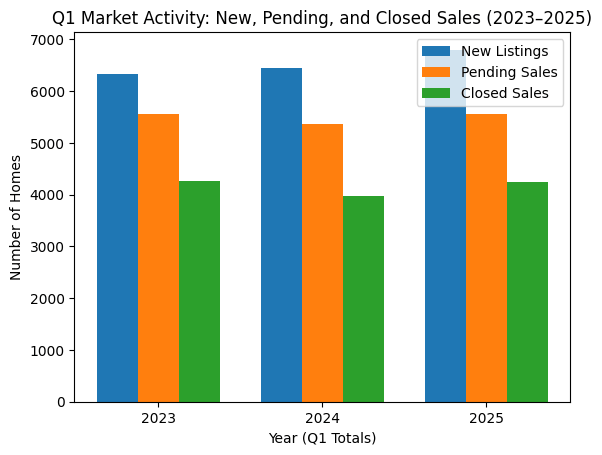
Closed Sales (Q1 Totals)
-
2023: 4,267
-
2024: 3,982
-
2025: 4,254
We’ve been living in a tight range of roughly 4,000–4,250 closed sales in Q1.
That’s not volatility.
That’s predictability.
Pending Sales (Q1 Totals)
-
2023: 5,553
-
2024: 5,372
-
2025: 5,566
Roughly 5,400–5,600 homes go pending in Q1.
Buyers are still buying. Just more selectively.
New Listings (Q1 Totals)
-
2023: 6,325
-
2024: 6,451
-
2025: 6,802
Supply has been running between 6,300–6,800 new listings in Q1.
This is what a post-adjustment market looks like. Balanced inflow. Balanced absorption.
Here’s the Opportunity
This is not a frenzy market.
It’s not a distressed market.
It’s a balanced, math-driven market.
And balanced markets reward strategy.
In a frenzy, almost anything sells.
In a downturn, very little moves.
In a balanced market, execution matters.
That’s a healthier long-term environment.
If You’re Selling
With roughly 6,500 homes coming on and 5,500 going pending, the majority of well-positioned homes still move. This will likely be the quarter with the fewest options for buyers to purchase.
But pricing discipline matters more than ever.
This is not the “list high and see what happens” era.
It’s:
-
Micro-market analysis
-
Studying absorption rates
-
Understanding buyer behavior at your specific price point
-
Building a pricing strategy, not a hope
I’ve written before that pricing is an art built on math. That’s even more true in a 6% rate environment.
Homes that are positioned correctly still sell.
Homes that are aspirational sit.
The difference is rarely luck.
If You’re Buying
You’re not competing with 20 offers on every house.
You’re not waiving inspections out of panic.
You have time to:
-
Analyze the micro-market
-
Compare true value
-
Negotiate repairs
-
Structure intelligent terms
In predictable Q1 volume, leverage shifts toward the prepared buyer.
You may not love the rate — but you do have room to negotiate. And strategy beats speed in this environment.
The Big Picture
The data tells us something important:
This market functions.
Around 4,000 homes will close in Q1.
Around 5,500 will go pending.
Around 6,500 will list.
That’s thousands of successful transactions in a 6% rate world.
Affordability may not be ideal.
But stability is powerful.
And stable markets reward advisors, not guessers.
If you’re thinking about making a move in 2026 — buying or selling — this isn’t a market to fear.
It’s a market to navigate intelligently.
And that’s exactly what I help people do.